High-Performance Antenna and RF Filter Technology Utilizing Core Source Technologies

Two core source technologies—dielectric materials and high-performance substrates—are essential for developing next-generation high-performance antenna and RF (Radio Frequency) filter technologies. These technologies are critical enablers of ultra-high-speed, ultra-low-latency, and high-reliability communications required in future communication systems beyond 5G and 6G, as well as in various advanced fields such as autonomous driving and satellite communication.

Importance of Dielectric Materials

Dielectrics are materials that exhibit electrical polarization when an electric field is applied.
In antenna and RF filter applications, they are used to optimize performance by adjusting electrical properties.
In particular, dielectric materials with dielectric loss (tanδ) and high dielectric constant offer the following advantages:

  • Realization of antenna miniaturization and high efficiency.
  • Performance improvement of RF filters.
  • Flexible response to various communication standards and service requirements through frequency selection and bandwidth control.
  • A key driver for enhancing the performance of antennas and RF filters.

Importance of High-Performance Substrates

The substrate used in the manufacturing of antennas and RF filters has a direct impact on their performance. In high-frequency environments, stable operation requires high-performance substrates with the following features:

  • Low-loss, low-dispersion substrate that minimizes signal attenuation, increases transmission efficiency, and reduces signal distortion to maintain communication quality.
  • Substrate with mechanical strength that is resistant to heat, has low deformation, and can withstand physical shocks.
  • Substrate suitable for fine patterning and multilayer structure implementation to realize complex antenna and filter designs.

Technological Synergy of Dielectric Materials and High-Performance Substrates

  • Contributing to the integration of high-performance antennas into confined spaces such as RFID and IoT devices by applying high-dielectric-constant dielectric materials to high-performance low-loss substrates and developing ultra-compact, high-efficiency antennas.
  • Enabling the implementation of high-power RF filters by combining dielectric materials with dielectric loss and substrates with excellent thermal stability (applicable to high-power-demanding areas such as base stations and satellite communication systems).

Dielectric materials and high-performance substrates are fundamental core technologies for the advancement of high-performance antenna and RF filter technologies.


Ceramic Patch Antenna Matching Technology

Ceramic patch antennas exhibit significant variations in characteristics depending on the surrounding environment, making precise tuning essential when applying them to actual products.

Factors Affecting the Characteristics of Ceramic Patch Antennas

Ceramic patch antennas experience changes in input impedance and resonant frequency due to various factors:

  • Characteristics of the patch itself: The size and shape of the patch printed on the dielectric body determine the unique impedance value and resonant frequency.
  • Ground plane: The thickness, size, and material of the ground plane on which the antenna is placed affect the antenna’s impedance and resonant frequency.
  • Boundary conditions: The antenna characteristics change depending on the boundary conditions between measurements in open air and actual installation in a product housing.
    In particular, the paint composition or mechanical properties of the product casing can have various effects.

Example of Resonant Frequency Change

In general, the resonant frequency tends to decrease as the ground plane size becomes smaller or as the antenna is mounted into the product housing.

Subject Condition Resonant Frequency Change
25x25 mm Ceramic Patch Antenna 70x70 mm Ground Plane 1575.42 MHz
28x28 mm LNA PCB 1565~1570 MHz
Mounted in Product Housing 1555~1565 MHz

Need for Tuning for Optimal Performance

  • Tuning is necessary to achieve accurate resonance and minimal return loss at the target frequency (e.g., 1575.42 MHz).
  • This includes structural adjustments to raise the resonant frequency and re-matching the impedance.

Matching Technology for RFID Reader Antennas

  • The same matching process is crucial for RFID reader antennas.
  • For RFID antennas using a single port for both transmission and reception, this matching technology is key to maximizing reading distance based on the antenna’s gain value.

Based on our core material technology, we possess a variety of RFID antennas, and recently, we have developed and commercialized high-performance antennas that are smaller and lighter in response to the trend of miniaturization and weight reduction in RFID antennas.

Possession of Antenna Design Technology and Measurement System

Optimized antenna design is an essential element in today’s rapidly evolving wireless communication environment, and efficient antenna development serves as a core competitive advantage for wireless communication systems.
In the past, antenna design relied heavily on actual fabrication and measurement, consuming significant time and cost. However, with the advancement of design tools, faster, more accurate, and more efficient antenna design is now possible.

Possession of Antenna Design Technology

  • Before actual fabrication, various design parameters (size, shape, material) can be adjusted in antenna design tools to quickly predict characteristics, and the accumulated design know-how is utilized for analysis.
  • Through reduced design time and cost, performance prediction and optimization, analysis of complex environments, and early identification and resolution of potential issues, we can rapidly provide optimized results tailored to customer requirements.

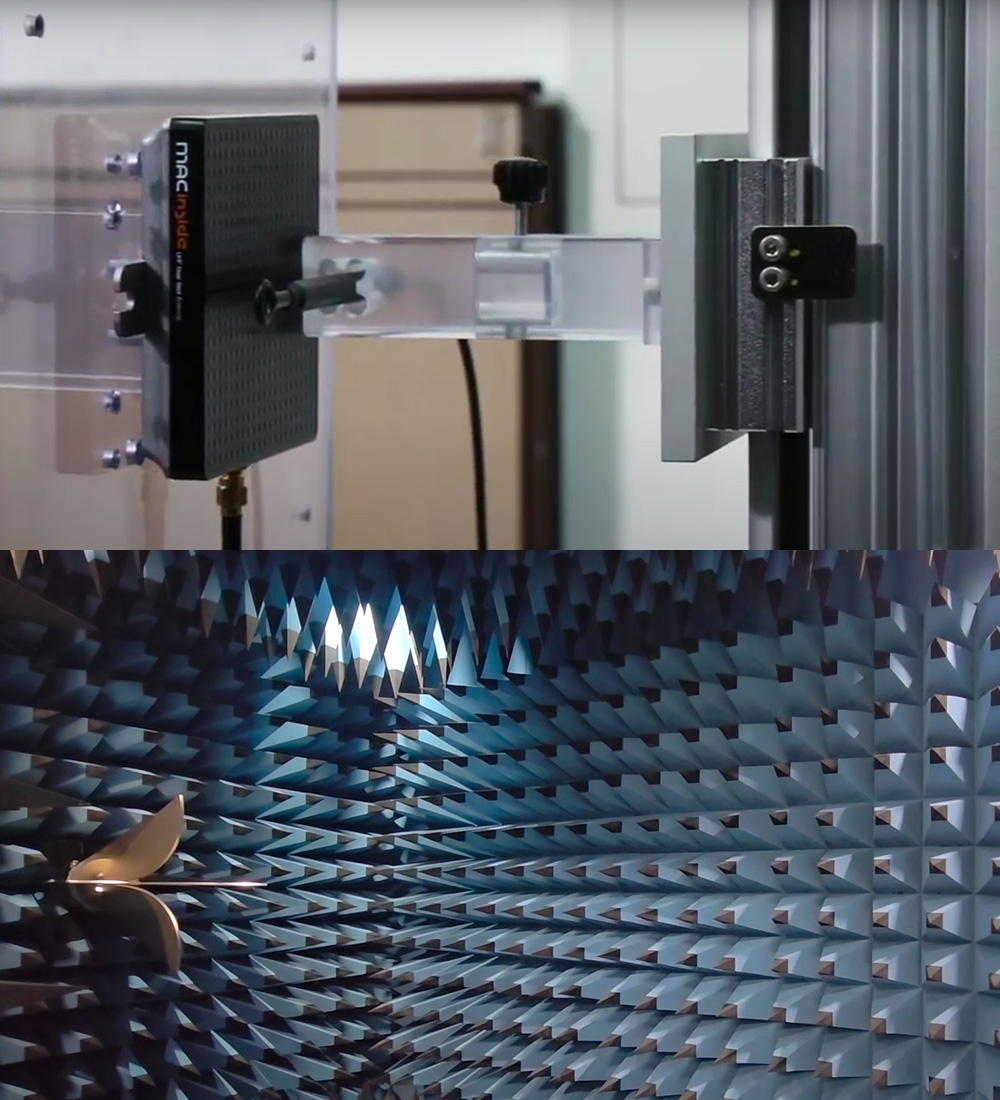
Possession of Antenna Measurement System (Anechoic Chamber)

Optimized design using simulation tools is the first step in antenna development, and performance verification through a measurement system after fabrication is essential.
This process clearly reveals the differences between simulation results and actual environments, ensures confidence in the final product’s performance.

The combination of antenna design technology using simulation tools and a precise measurement system is essential for antenna development.
These two elements create a synergistic effect, enabling the efficient development of high-performance antennas and, furthermore, providing reliable antenna solutions for various wireless communication systems.